Supported Independent Living: Who Pays for an Empty Room?
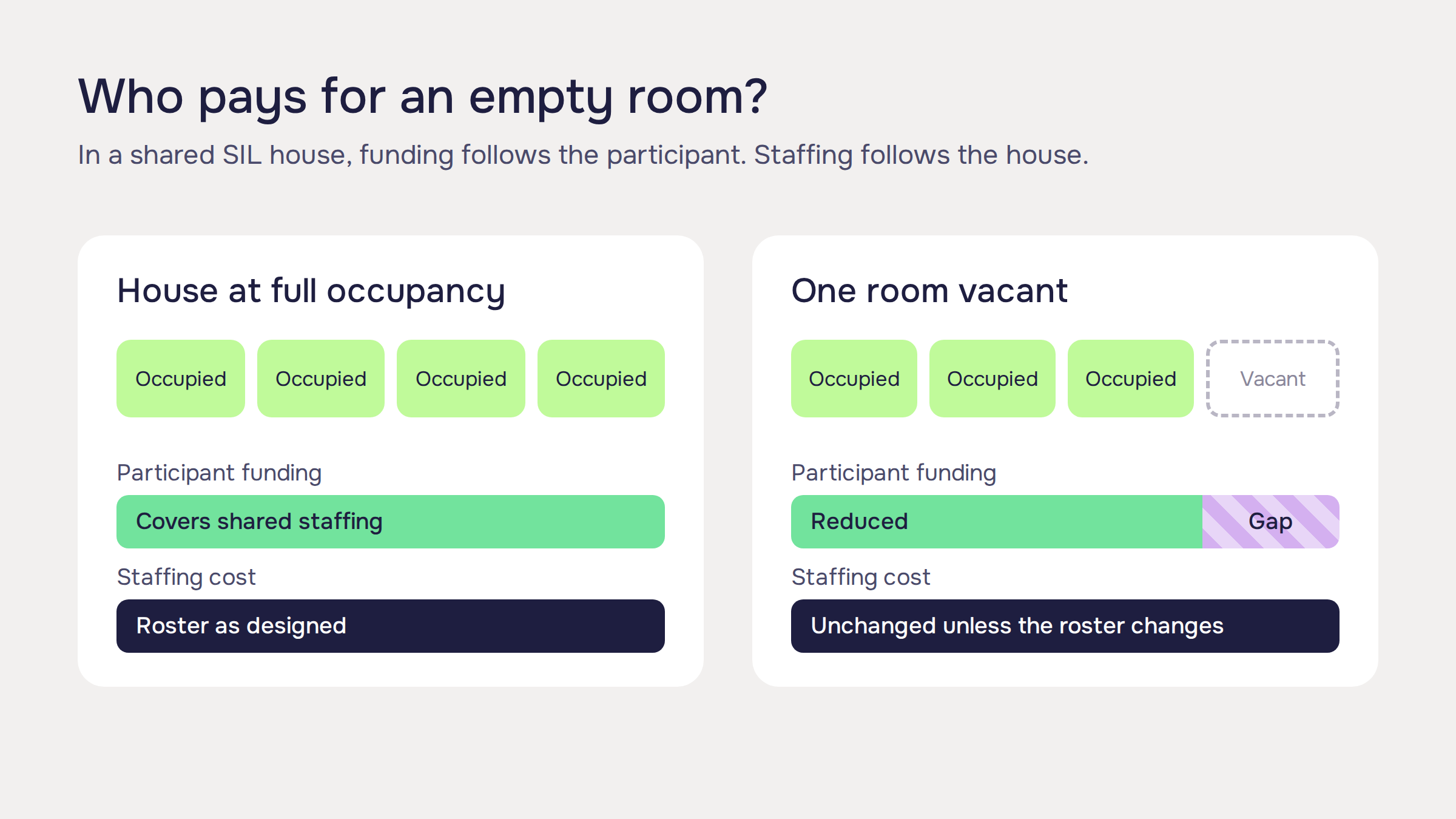
In a shared Supported Independent Living house, revenue and cost move on different clocks. Revenue is tied to the participant: their funding, their plan and their ratio of support. Cost is tied to the house, because the roster still runs, the rent is still due and staff are rostered on, regardless of occupancy.
A house with three or four participants funded at a shared ratio can usually be flexible around one person being briefly unwell or away for a few days. However, when a room is unoccupied for longer than that and the carer ratio doesn't change, earnings are reduced.
This article explains who pays for an empty room in supported independent living and looks at how to minimise losses.
In short:
- In shared SIL houses, revenue moves with occupancy but staffing costs don't, so an empty room still generates a full cost.
- Providers handle this inconsistently by absorbing it, informally adjusting rosters, or occasionally recovering it through vacancy provisions, with no settled position.
- One empty room is a manageable gap, but the same pattern across several houses becomes a recurring cost that can be difficult to manage.
- Ratios can be adjusted within limits when occupancy changes, provided remaining participants' support needs are still met, but this only works if rostering actively tracks it.
- Location-based rostering makes occupancy and ratios visible at the point rosters are built, so the cost of a vacant room becomes a deliberate decision rather than one discovered after the fact.
- Visualcare has specific tools and features to support SIL providers.
Why the ratio model exposes providers to cost pitfalls
Funding for the reported 17,000 Australians who live in Supported Independent Living is built around shared ratios. A participant's plan funds their share of a staffing ratio, on the basis that the cost of a support worker is being split across the people in the house.
For example, there may be two workers present overnight for four participants, and one worker rostered on to support three participants during the day, depending on levels of ability. The ratio is what makes SIL viable for the provider, because the alternative of one-to-one staffing usually costs more than a single participant has funding for.
The problem with the ratio is that it only works as intended when the house is at the occupancy it is designed for. Every participant's funding is contributing their share toward a fixed staffing cost. Take one participant out of that equation to have 1:2 instead of 1:3 support, and the staffing cost unfortunately doesn't shrink to match.
This is different from a single NDIS participant service, where an empty slot means no service and no expenses incurred. In a shared house, an empty room still generates a full cost, because the rest of the home is occupied and the roster has to keep running to accommodate the other occupants.
The number nobody is taking note of
This situation isn't rare, but can cause problems for SIL providers who are covering the lease, and most don't have a documented answer for how to handle it. Some absorb vacancy gaps as a cost of doing business, treating it as a margin risk that comes with the model. Others quietly redistribute it, adjusting rosters informally when a room is empty for an extended period.
Neither of these is necessarily wrong, but the lack of a settled position is itself a risk. A provider that handles unoccupied rooms differently from house to house, or from one long-term vacancy to the next, ends up with cost outcomes that are effectively a matter of who happened to be managing the roster that week, not a deliberate operating decision. And because SIL houses are usually hosting multiple individuals, each with their own funding source, the scale compounds quickly.
A single empty room in one house is a manageable gap. The same pattern across several houses, particularly if a provider is scaling SIL as part of its service mix, becomes a material and recurring financial pitfall that's never been priced in as a planned part of the business.
Read more: Ultimate Roster Systems Guide for Home Care, NDIS & Supported Independent Living
The revenue impact of empty rooms
Part of why this issue is underdiscussed is that it doesn't show up as a single, obvious number.
It can be spread across houses, across weeks, across participants coming and going for reasons that have nothing to do with rostering. It's absorbed into the general staffing cost of running SIL, and it only becomes visible when someone goes looking for why a particular house is running at a thinner margin than it should be.
That's also why it's easy to underestimate. A provider running several SIL houses, each with occasional vacancies for entirely ordinary reasons, hospital stays, transitions, plan reviews, can be carrying a meaningful and recurring cost without it ever being properly identified.
Compare that to a provider who can see occupancy against staffing ratio for every house, in real time, and who has a clear, consistent process for what happens to the roster when there are vacancies. The second provider isn't necessarily paying less in any single instance. The difference is they're not being caught by surprise.
Empty rooms: what can you control?
The staffing cost of a SIL shift is largely fixed once a house is designed around a ratio, but not entirely. This is where rostering becomes the practical lever.
Ratios can be flexible, within limits, to reflect a change in occupancy. If a house is funded and staffed for four participants overnight at a 3:1 ratio, and one participant is away for an extended stay, there may be scope to reduce the overnight ratio for that period, provided the remaining participants' support needs and any plan or funding requirements are still being met. That's not a decision to make casually, and it depends heavily on what each remaining participant's support needs actually require. But it is a lever, and one that only works if the roster is actively managing occupancy as it changes.
The alternative, leaving the roster exactly as it was built regardless of who's actually in the house, guarantees the full cost is worn every time a room is empty, with no attempt to bring it back into line.
How rostering software delivers the steps to a solution
Visualcare's purpose-designed rostering platform supports ratio care directly, letting providers build rosters around a house rather than a single participant, and set ratios that reflect actual occupancy, such as two workers per four participants, or one overnight worker per three with two rostered during the day.
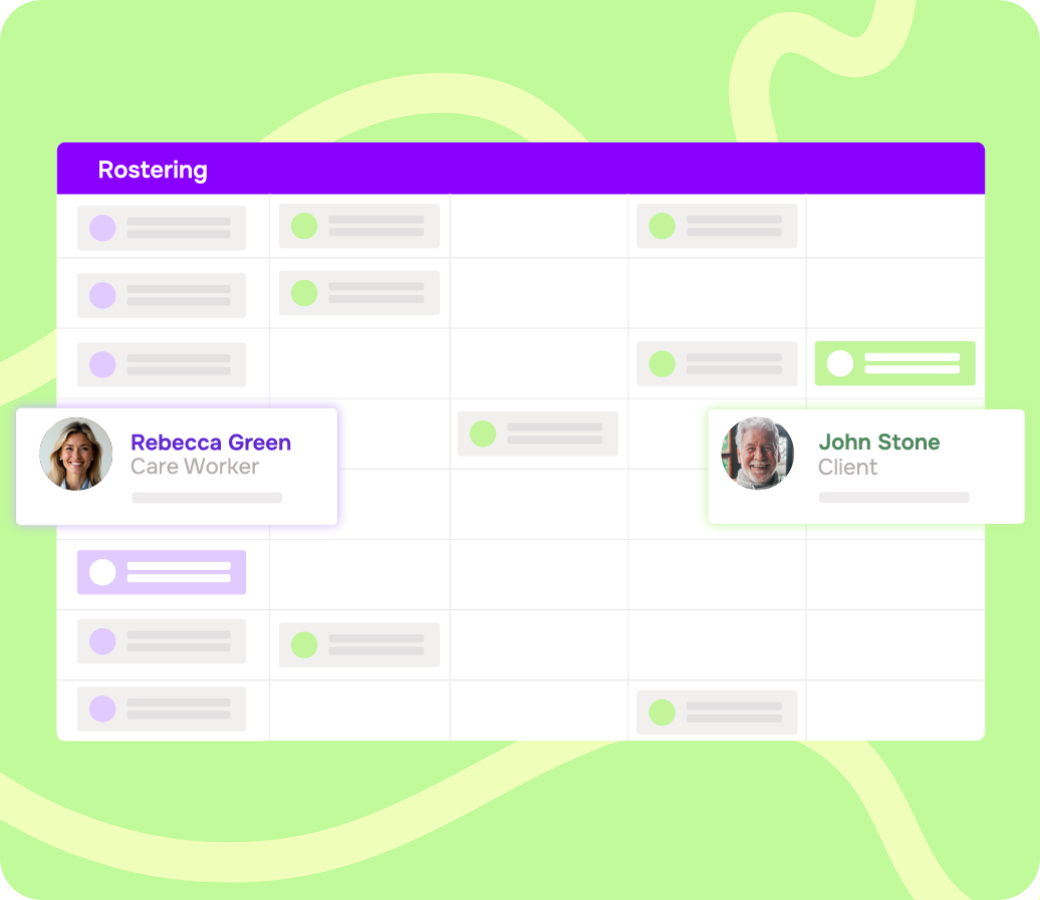
When occupancy changes, that ratio is visible and adjustable at the roster level, rather than buried in a spreadsheet or worked out informally after the fact.
This doesn't remove the underlying decision providers need to make about how to absorb the cost of vacancies. That's a policy-related question, and one worth having a consistent answer to. But it does mean the decision can be made deliberately, with visibility into occupancy and ratio at the point the roster is built, rather than discovered after the fact when a house's margins don't look the way they should.
Request a demo to see how Visualcare's rostering tools help SIL providers manage ratios and occupancy.
Request a Demo
Let us show you how Visualcare can work for your care organisation.