In the home care and NDIS industry, shift notes are essential to ensure compliance and quality of care. These notes detail what has happened on the shift so the next person who steps in is informed and can respond accordingly, but the notes themselves can often lack consistency.
Here are some essential steps to remember for creating shift notes, what to log and how to ensure information doesn't go missing.
Who accesses shift notes?
Workers, care coordinators and business administrators and managers are all working towards a common goal, but they experience shift notes very differently.
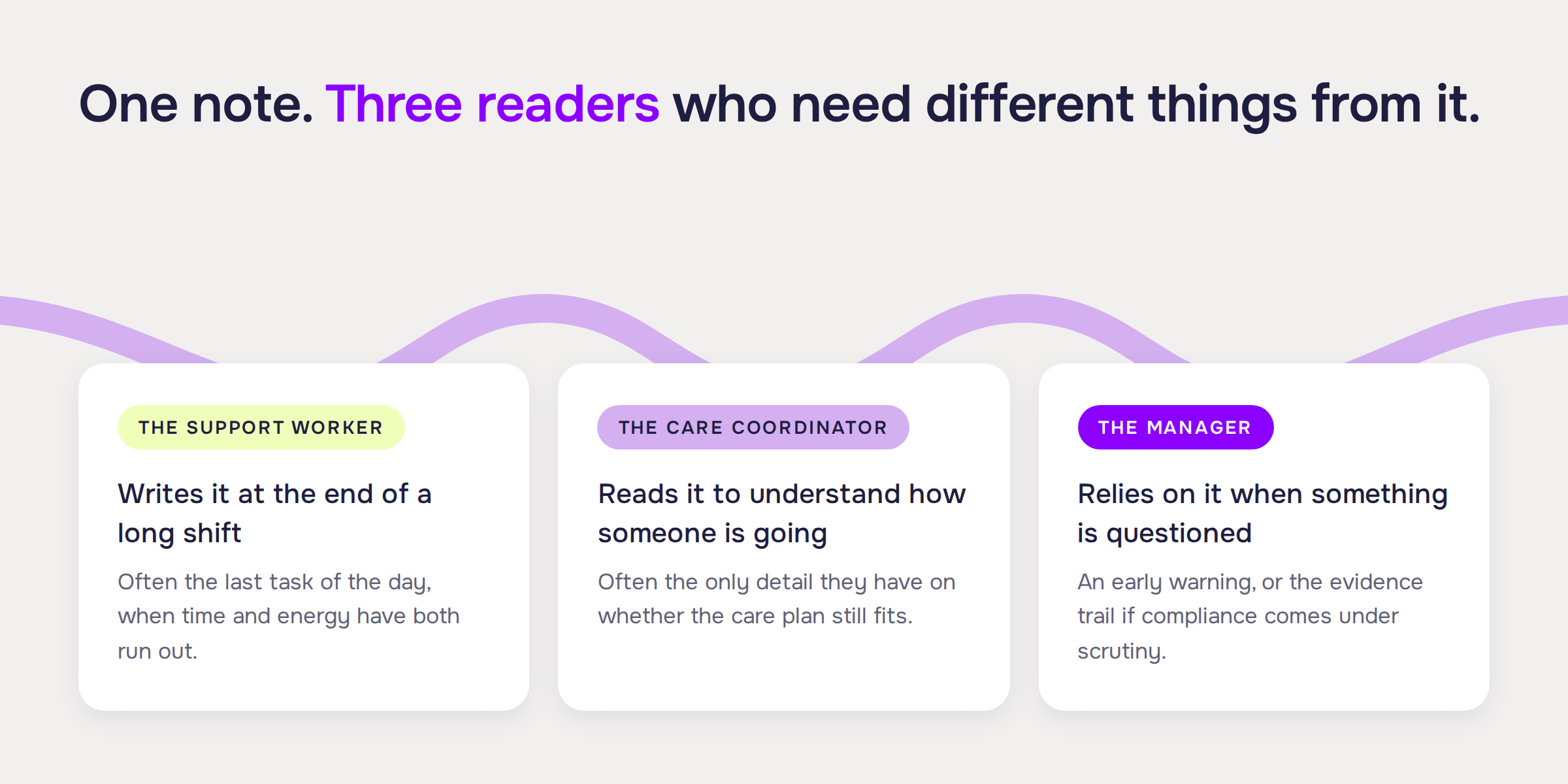
For a care worker, a note is often the last task at the end of a long and demanding shift. For a care coordinator, that same note might be the only details they have to understand how a participant is actually going, whether there is anything to be immediately concerned about, or whether a care plan is still fit for purpose.
At the administrative level, a shift note can be a warning that something needs attention, or an essential piece of evidence if compliance comes under question.
When a note is rushed or minimal, the worker has technically completed their task, but the next team member coming on shift is at risk of being left without the information they need to do their job well. Multiply that across a roster of workers and shifts, and the provider's overall visibility into how well participants are being cared for can be affected.
The "shift complete" problem
The most common failure is also the simplest to describe. A worker marks the shift as complete, perhaps with a note that says little more than "shift complete" or "no issues," and moves on. Technically, a box has been ticked, but on a practical level, nothing useful has been recorded.
This is often a symptom of time pressure, an unclear sense of what's actually expected in a note, or a blank text box within an app or spreadsheet that doesn't prompt for anything more specific. Whatever the cause, the result is a record that satisfies a compliance requirement in the loosest possible sense, while providing no real information to anyone who reads it afterwards.
The anatomy of a good shift note
At minimum, a shift note should capture what happened during the shift, including anything relevant to the participant's wellbeing or any tasks completed. It should flag anything the next worker needs to know before their own shift starts, such as a change in mood, a missed task, or a medical or wellbeing concern to follow up on.
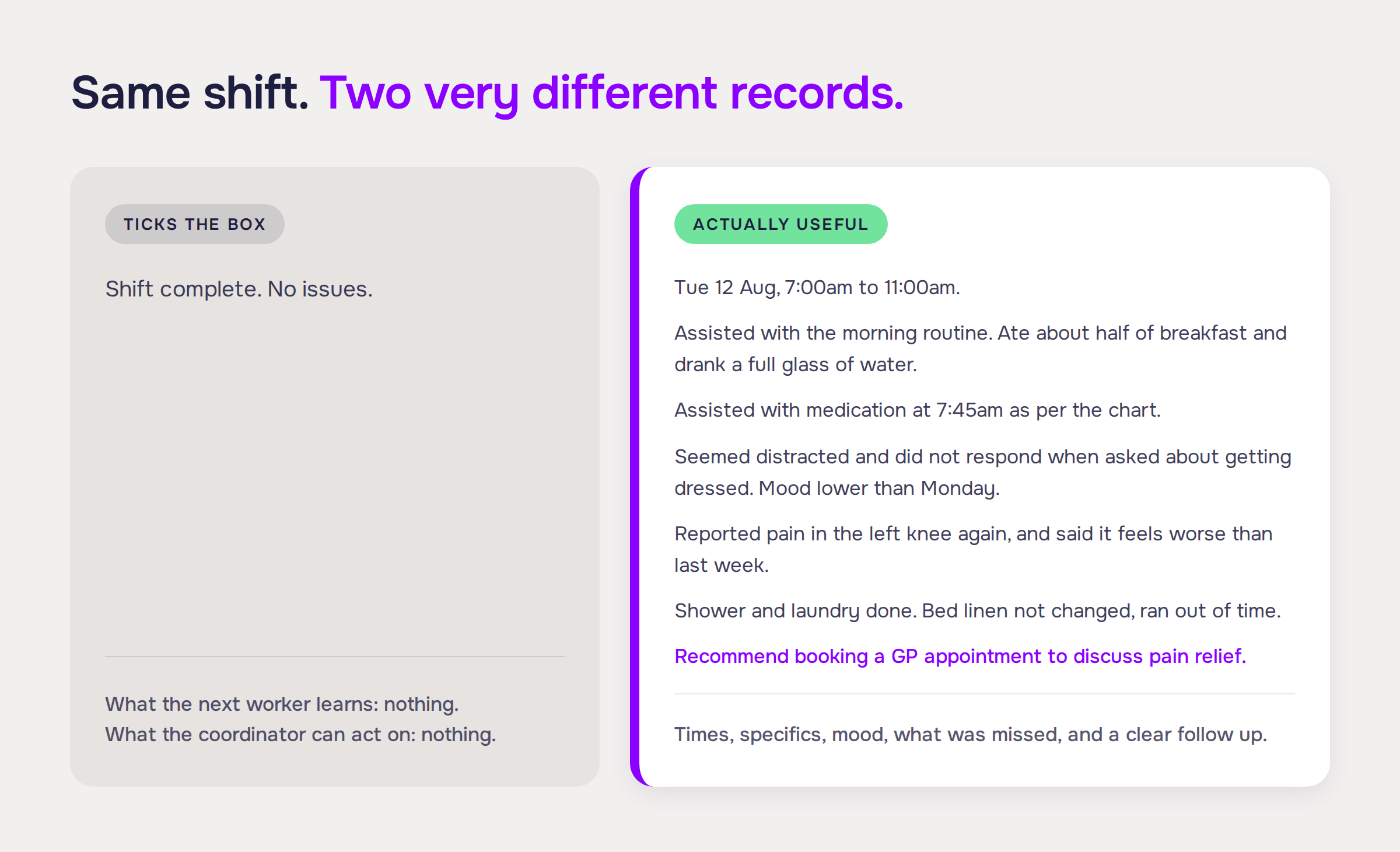
Noting medication administered and any care tasks completed is particularly important. Finally, a good note contributes, even briefly, to a picture of progress against the participant's broader care plan, rather than treating each shift as an isolated event. A few clear, specific sentences covering these points are better than a long note that doesn't answer them.
Other elements to include
Speaking English as a second language is common across the care workforce in both aged care and NDIS, and this creates a real and often underacknowledged difficulty in writing clear shift notes. This is why using plain language, with as little jargon as possible, is important.
Read more: Ultimate Roster Systems Guide for Home Care, NDIS & Supported Independent Living

The importance of centralised care worker shift notes
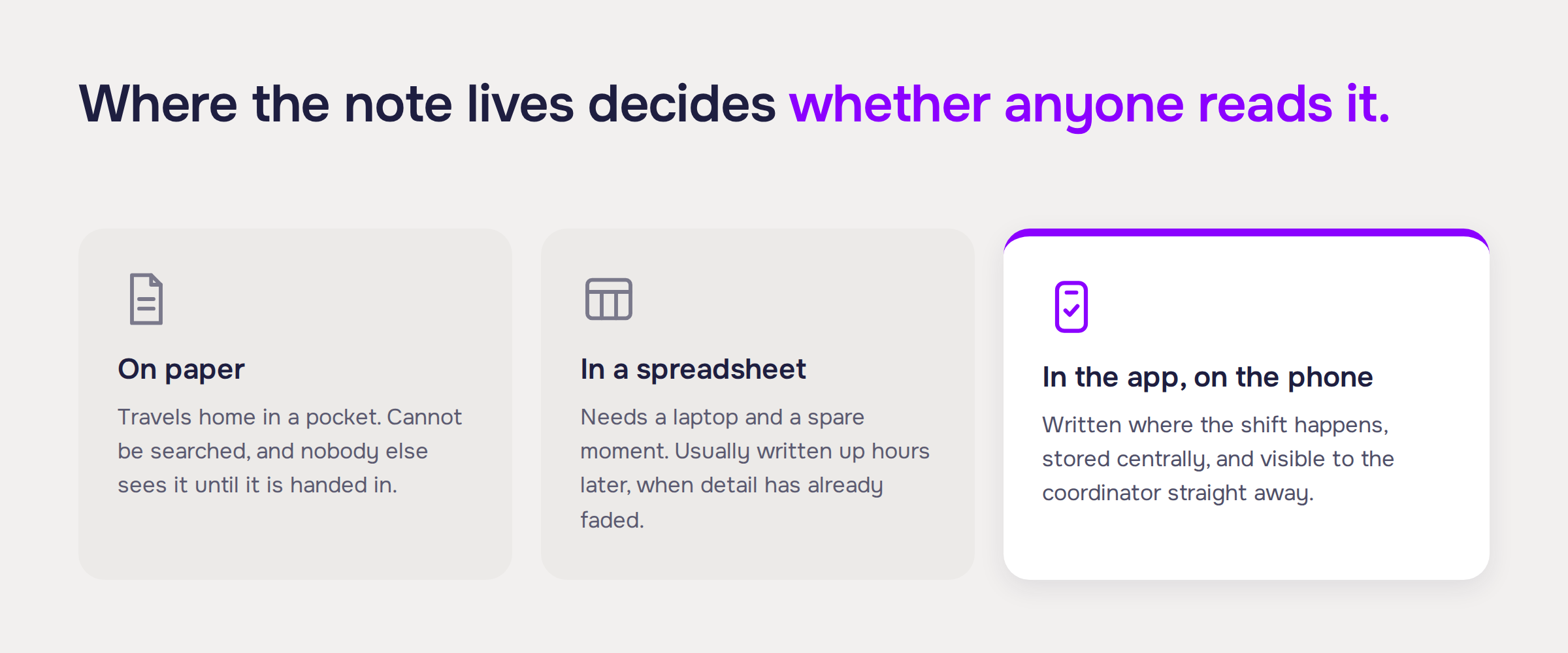
Pieces of paper with shift notes are a recipe for confusion. Spreadsheets aren't much better, particularly if they can only be easily accessed and updated via a laptop or desktop computer.
The best solutions allow shift notes to be entered within an app that is cloud-based and updated in real time. This way they are stored somewhere central and can be easily accessed by the relevant stakeholders.
If the app can provide shift details including start and end time, address and tasks required as well as shift notes, the worker will have all the information they need at their fingertips.
Additional functionality that makes a difference includes secure one-to-one and group messaging, and timesheets that can be updated and immediately accessed by payroll, so pay is compliant and timely.
Why care workers appreciate Visualcare
Visualcare's rostering app is designed to work wherever a mobile care worker is, whether that's at someone's home or between visits. This platform makes leaving shift notes easy and also provides helpful functionality to show shift and participant or client information, make swapping and accepting shifts easy, and exchange messages with the administrative and roster management team.
For a workforce that's often stretched, working in English as a second language, or juggling shifts across multiple providers, having one simple, reliable place to record and access shift notes makes a genuine difference to how manageable the job feels.
Want to see how Visualcare can improve shift notes and worker experience for your team? Book a demo today.
Request a Demo
Let us show you how Visualcare can work for your care organisation.