Recruiting care workers and reducing turnover are the hardest ongoing challenges for home care and NDIS providers.
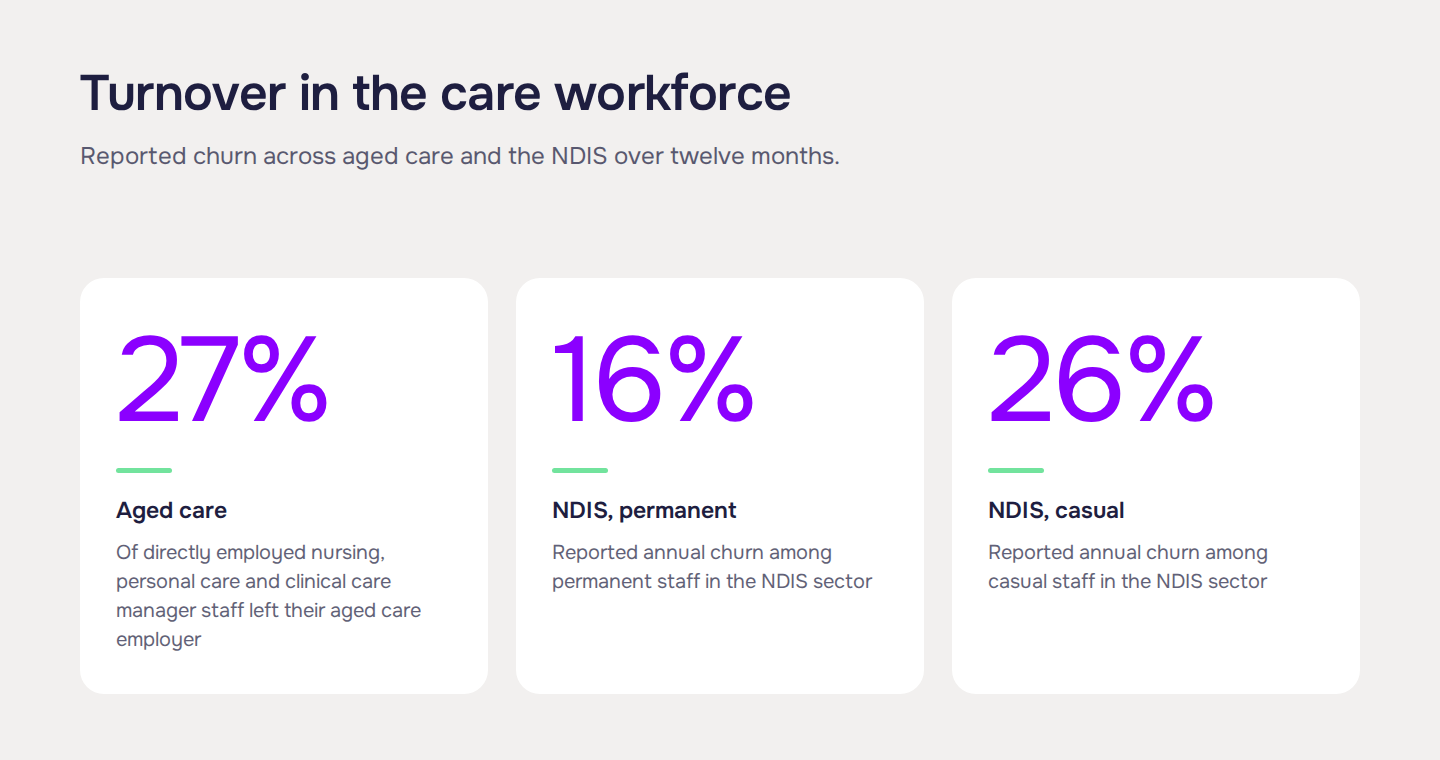
Demand for talent keeps growing, but the workforce needed to deliver it is under strain. Vacancies are hard to fill, and retention is its own challenge. As one study found, 27% of all directly employed nursing, personal care and clinical care manager staff left their aged care employment over a 12-month period. Meanwhile, the NDIS sector reportedly experiences 16% churn for permanent and 26% for casual staff.
Every departure disrupts continuity of care, adds pressure to remaining staff and impacts the overall budget. For providers trying to run a sustainable operation while meeting compliance and quality obligations, understanding what problems within the business may drive workers to leave is one step toward fixing the problem.
Understand the workplace challenges that cause churn as well as ways you can reduce turnover within the home care and NDIS industries:
In short:
- Replacing a care worker is costly, and the impact compounds as turnover increases pressure on remaining staff
- Safety is a retention factor as much as a compliance requirement
- Poor worker experience, including uninformed workers and late notice on changes, is a major and often underestimated driver of churn
- Unaccounted-for travel time creates unworkable rosters, contributing to poor worker experience
- Reducing turnover requires treating retention as an operational design issue as well as a recruitment one
The cost of losing a worker
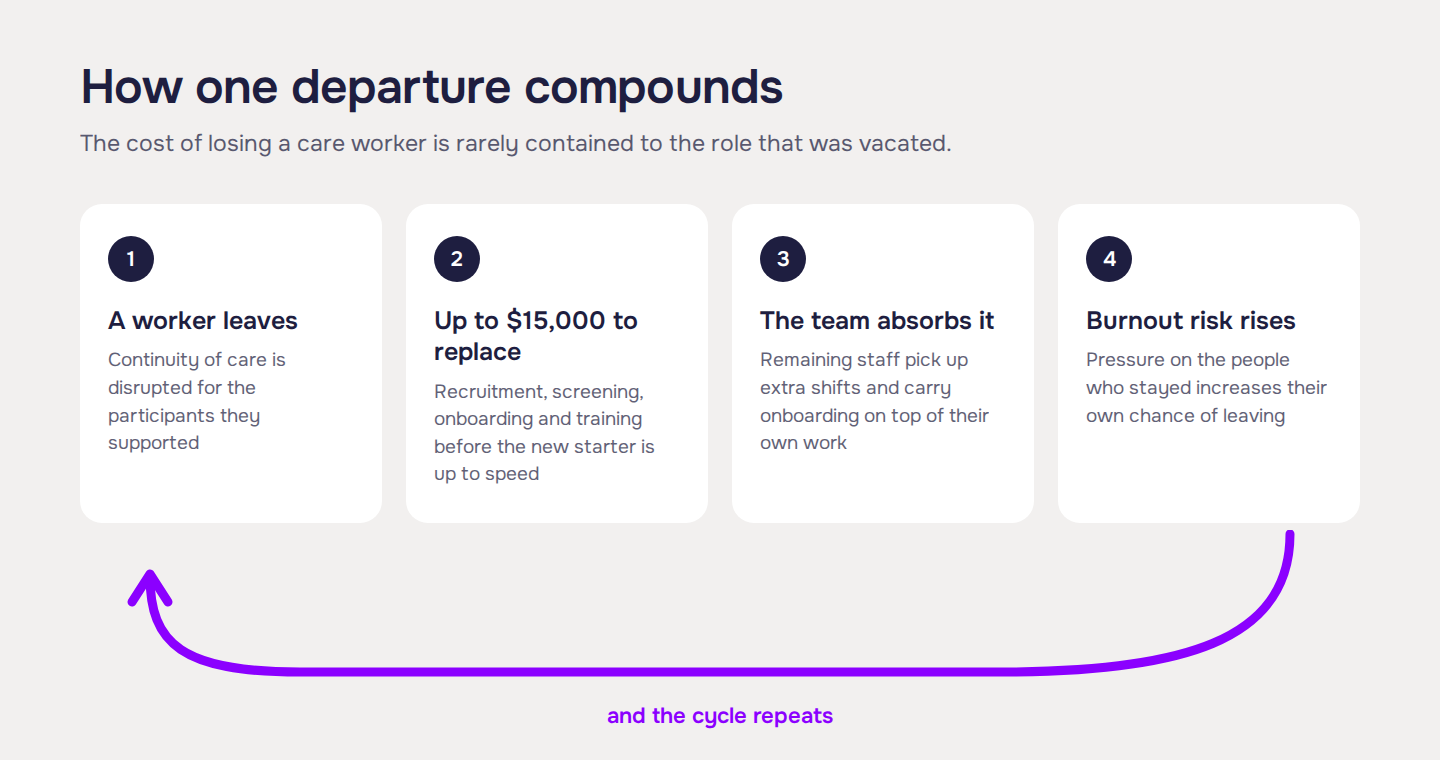
Replacing a care worker is expensive (up to $15,000 in recruitment costs). Recruitment, screening, onboarding and the training required before someone is up to speed and fully productive all add up, and that's before the lost productivity while a role sits vacant or a new starter finds their feet is accounted for.
For a sector already operating on tight margins, this is a cost that compounds. It also increases the burden on remaining staff, who absorb extra shifts and onboarding responsibilities, which in turn increases their own risk of burnout and departure.
Unfortunately, churn tends to create a downward spiral that can be difficult to recover from.
What causes churn in the care industry
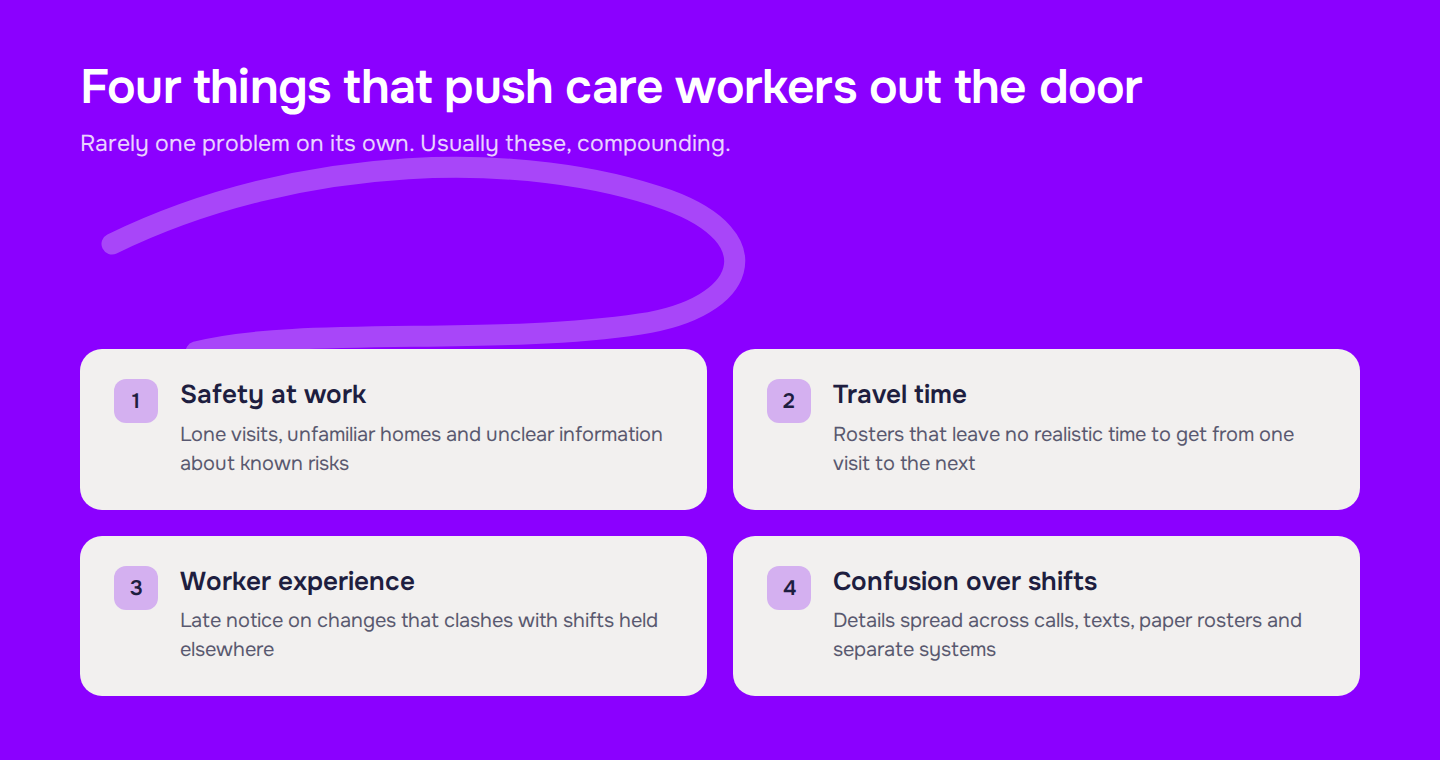
It's never a single problem on its own that causes someone to leave their role as a home care or NDIS worker, and with the acknowledgment that systemic challenges are an issue affecting the entire industry, the following may push talent to seek new providers to work with:
Safety at work
Safety is a significant factor in whether workers stay for the long term. Care work frequently involves lone working, unfamiliar environments and clients with complex needs. Where providers can't clearly demonstrate that a worker's safety has been considered, such as who they're visiting, what the known risks are, and how support can be reached if something goes wrong, workers are left carrying that uncertainty themselves.
A worker who doesn't feel adequately supported when it comes to safety is less likely to feel confident in their role, and less likely to stay in it. For providers, prioritising psychological safety may be an overlooked lever for retention.
Travel time
In community-based home care and NDIS support, workers routinely travel between participants. When that travel isn't properly accounted for in scheduling and pay, the cost can fall on the worker rather than the provider. It can also add to their stress as they rush to get between jobs.
A roster that looks efficient on paper can be unworkable in practice if it doesn't allow realistic time to get from one visit to the next. The result is workers who are consistently running late, or who are effectively working unpaid time.
Worker experience
The day-to-day experience of doing the job matters. When care workers have clear, timely information about where they need to be, who they're supporting, what's expected of them and what happened the last time a care worker visited, they're able to focus on delivering quality care.
Late notice on rostering changes is also a point of frustration. Many care workers pick up shifts from more than one provider, so a late change can create a direct conflict with a commitment elsewhere. Workers who repeatedly experience this start to see a provider as unreliable, and this can be a significant driver of them choosing to work elsewhere.
Read more: Technology that empowers operations management for care providers
Confusion over rostering and shifts
NDIS and other mobile care workers need clarity around where they need to be and when. If your team relies on manual processes or disconnected systems, shift details can be spread across phone calls, text messages, paper rosters and separate software, with no single place a worker can check to confirm what's actually happening on any given day.
A worker who receives conflicting information about a shift time, or finds out about a change secondhand rather than directly from the roster, starts to lose confidence in the system they're relying on. Confusion of this kind can also lead to missed or double-booked shifts, which then creates a service gap for the participant and an awkward situation for the worker.
Turnover isn't all about the on-the-ground team. If rostering and admin staff are frustrated by the systems they have access to and feel like things could be done better, they'll be more likely to look for other jobs.
Read more: Smarter scheduling for NDIS providers: How to stop rostering from running your day
Reducing turnover in home care and NDIS
Care industry professionals move roles for a number of different reasons, and not every problem in the industry can be solved overnight. However, providing a safe place to work, with a supportive team, clear information and realistic expectations can make a difference to turnover.
Rostering and scheduling are one place to start. Consistency, transparency and communication help ensure staff feel informed about their shifts. Quality rostering software from Visualcare can support this.
How Visualcare improves rostering and shift visibility
Visualcare's software is purpose-designed for the care industry:
For care workers
Visualcare's Worker app gives care workers clear, up-to-date shift details at their fingertips. NDIS, Supported Independent Living and home care workers can check tasks, location and shift notes and stay connected with their team. Everything they need for a shift, from address and timing to participant notes, is available in one place, accessible from their phone.
For care coordinators
Visualcare simplifies admin so coordinators can spend less time juggling spreadsheets or unsuitable rostering apps and more time focused on delivering great outcomes for participants. With a single source of truth for each participant's approved services, plan budgets and care preferences, coordinators can make faster, better-informed rostering decisions, and make sure their team has everything they need before a shift begins.
The other benefit of switching to Visualcare is cost savings; the software can help minimise double-handling of scheduling and reduce issues with payroll. As a result, there can be more budget available to support staff with upskilling and other initiatives.
Want rostering software your staff appreciates and can rely on? Book a demo with Visualcare today.
Request a Demo
Let us show you how Visualcare can work for your care organisation.